The car has been out for 4 hard days of testing and a few more quick runs behind our building. The purpose of these tests is to run the car hard so that anything that can break will break here where we can fix it, instead o fin the middle of a real race. The car weighed in at around 500lbs with a full fluids and ready to race tires. With a little care we could weigh in 400's which is somewhat competitive in the non-hybrid races, and unheard of in the hybrid competition. Another benefit to our minimalist hybrid drivetrain is that we might have one of the most powerful engines in this competition. Our drivers have been training for months in one of our older cars while waiting for the new one to be ready to run. We've been tweaking the spring stiffness, anti-roll bar stiffness, tuning the hybrid controller, and checking for sound levels. Ok I have to go now, but here are some videos:
Failing the sound test by 1db, but it's an easy fix
A quick video of us driving on internal combustion engine only. With the electric system entirely shut off it should still be faster than the winner last year.
Showing posts with label Formula Hybrid. Show all posts
Showing posts with label Formula Hybrid. Show all posts
Thursday, April 9, 2009

Formula Hybrid Assembly

Me and the Texas A&M 2009 Formula Hybrid car


We (the Formula Hybrid team) spent the entire Spring break wrapping up the build of the car. Building takes forever because there are a million little parts, welds, and little details that were overlooked during design. Multiple parts had to remade because they didn't fit, didn't work, or interfered with other parts. There were no major screwups, but a whole lot of little ones.
A 3d model of the hybrid powertrain
By Wednesday the build room had been converted into a paint booth, and the car was painted. The paint dried for a few days, and Friday at 5Pm we started assembling everything. While the rest of my peers were partying it up on Spring Break, we were busting our butts on this project.
The steel space frame chassis being painted
Assembly started at 5PM and by 3AM the car was assembled and on the ground rolling. The next week was spent wiring the engine, electronics, high voltage electronics, motor, and batteries. We had a deadline of Friday, March 27th to have the car assembled. That Friday was the rollout presentation in front of a board of engineers who reviewed and critiqued our design. We were ahead of schedule, and even took the car on a test drive the night before. We were the first design team in A&M Racing's history to have a car driving under its own power at the rollout presentation.
The car at the rollout presentation
This left us with just over a month to test and tune the car. Our theory is that winning teams have 1) a reliable car 2) a fast driver 3) a fast car. By getting out to drive a full month before the race day, everything that could break during competition will have already broken and fixed. The drivers will have hours and hours of experience driving this type of car and get the feel for it. So far we've had 4 hard days of testing and tuning with only 1 problem. A wheel speed sensor, which is a small metal ring resembling a gear, unbolted itself from the motor. The manufacturer right hand bolt hole in the end of the motor shaft, but it needs a left hand because the motor spins in a direction that tries to constantly unscrew the bolt. Loctite (superglue) solved the problem. Also, the carburetor keeps trying to fall off because the junky connector is plastic. It has been amazingly reliable, fast, and easy to drive considering we were all inexperienced in this and certainly none of us have ever tried to build a hybrid car before. Nobody knew for sure how it was going to perform as a hybrid because of unplanned interactions between the electric motor and the internal combustion engine. It works just as planned, despite what some of the more vocal engineers on the advisory committee thought. Next week we will be practicing for the design event and bossiness presentation, which means I still have alot of work to do. We will be driving to New Hampshire from College Station, which is a 6-day, 4,000 mile round trip. We have to tow the car, 3 sets of wheels and tires, a spare engine and motor, tire machine, full set of tools, and the welder, so we will be towing a monster trailer.
The car and the team completely assembled
Here is a little video of the assembly of the car:
Monday, January 19, 2009
Building the Formula Hybrid Car
 The chassis team leader putting the 4130 steel frame on the jig
This is the 1st post on building the Formula Hybrid car, there will be more if I am not busy building the car to write about building the car. The only reason I have time right now is because I managed to get myself sick by working all day every day instead of sleeping. Hopefully tomorrow I will be back in the machine shop, making the motor mount on the mill.

CNC (robotic) milling a block of aluminum to make the motor mounting plate
The team has spent nearly 6 months designing thing son paper, and just two weeks ago we made the first cut of metal. Since this is a hybrid car, and none of us had any experience with hybrid drivetrains, the motor and control tea started working on this last January when the construction of the 2008 car was just beginning. Now 1 day shy of 1 year later, we got our hybrid drivetrain to run this morning, Hurray! The design team is composed of 7 teams:
-Suspension, brakes, wheels, and tires
-Chassis, cockpit, and body
-Drivetrain
-Engine
-Motor and Controls
-Batteries and High Voltage
-Low Voltage and Data aquisition
The engine is mostly stock (if Nascar is "stock" than so is this) so there is not too much work to do there. Our car will also have onboard engine, motor, temperature, and battery monitoring sensors as well as wheel speed sensors, GPS data logging, 3-axis accelerometers and suspension travel measurements. The software we use plots all of these on a GPS acquired map of the course, and allows us to tune the cars suspension, engine, and motor.
 A 3D model of the front suspension and steering allows us to test for structural integrity based on spring compression, tire friction and roll stiffness during high g corners.
The teams are 2-3 people, except chassis which has 4 (and needs 7). There is an 8th team, called the "architecture team" that decided how our hybrid car would be put together. I am on the motor and controls team and the architecture teams. We are the hybrid part of the hybrid car. I am the only mechanical engineer on the electrical side of the design. There are really two architectures of a hybrid car- series and parallel. A series car is essentially an electric car that has a gas powered electric generator. It is efficient because the engine can always spin at its optimum speed, but heavy because it must have big batteries and a generator. Most Formula Hybrid cars, including every winner, has been this design. A parallel hybrid car is like a regular car, except that the electric motor is much smaller, and only helps out the gas engine when it is not powerful enough. The motor and batteries can be much smaller and lighter to achieve the same power. Decreasing weight is a great goal for a racecar, and the reason we chose this method. The drawback is reduced fuel economy. We don't care about fuel economy because we are racing against the clock, not the gas tank. Lighter is faster, and that's what really matters (in racing, not highway driving). This method is more complex to pull off in terms of electronics and many times more difficult to design around. The engineer must balance the weight of the motor and batteries and motor against the power gains to select just the right size and configuration.
The Yamaha WR 250 engine, still in the bike for early tuning, with titanium exhaust
Our design will use a 250cc Yamaha dirt bike engine. It's small, but can put out plenty of power for its size. It will also have a very nice titanium muffler kit and an autoclutch. The electric motor we are using is actually an industrial forklift motor. We will be using two boxes full of powerdrill battery packs to power the motor. To recharge the batteries we are going to use the drill companies chargers plugged into our car. We will carry about 30lbs of batteries compared to nearly 300lbs that other teams have used. Also, we modify the battery packs to get nearly 5x more power out of them. A very fancy electric part called a GFI senses if there is a short circuit or someone touching the wires, and automatically shuts down the batteries to prevent injury.
 One of the welders uses tungsten-inert-gas welding to put together the frame
The team is working steadily, and we hope to get done in about 10 weeks. That's a tight schedule. Most teams spend a few months designing and a year building, not the reverse. However, no matter how well constructed your car is, you can't win with a bad design.
Formula SAE Driving
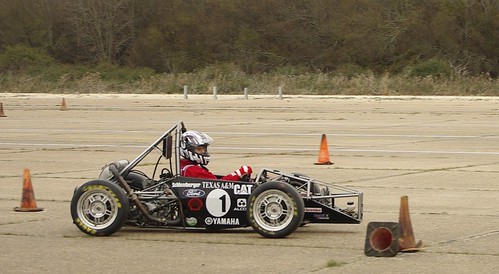 Me driving the 2006 1st place Formula SAE car, converted to stock
The Formula Hybrid team has been busy 24/7 since just after the new year working on the new car. Just for a relaxing day, we took the old car out for a fun day of driving. Last semester a small handful of the team took the task to fix the 2006 Formula SAE car, which won the 1st place in the competition, and won the Road&Track magazine's Triathlon trophy. It previously had a supercharged single cylinder ATV engine , custom exhaust and intake, with an $5,000 aftermarket engine controller that mapped the ignition and injection timing by reading the manifold pressure, speed, and throttle position sensor. If that didn't make any sense don't worry, it was really cool, really powerful, and really unreliable (surprised?) We removed the siezed engine, and replaced it with a stock engine, stock exhaust, and a carburetor. After that we tore out the entire wiring harness and started over. After fixing the shifter and suspension, it was time to drive.
 Suited up and ready to drive
I got the opportunity to drive the course first yesterday. It is a very tight autocross style course that limits your speed to less than 60mph, but can require turning at ~1g. Our practice "track" is actually a crappy old runway covered in dirt and grass, oh well. Driving one of these cars requires special safety equipment: a thick engine firewall, five-point safety harness, fireproof suit, gloves, and shoes, a helmet, and arm restraints. The arm restraints tether your arms to the car so you don't break them when the car flips. Rolling the car is pretty unlikely, because the roll center is only about 10.5" off the ground, nearly even with the center of the wheels. The car would have to lean nearly 90 degrees before it would roll over! This leads to very good cornering performance. We also took this opportunity to familiarize the car to potential drivers for the future. A few people we know through various connections who are not on the design team have Formula and Kart racing experience, and may be driving for us. Most of the design team members are engineers, not drivers. Our only experienced driver is about 6'4" and 300lbs, which means he just won't fit. At 6' even, and 170 lbs, I am at the very limit of what fits in the car. It was designed to fit only one driver, and he was much smaller (and faster) than me.
 Patrick wondering why the clutch won't work, turns out the cable snapped
The clutch cable snapped after a dozen laps, but we brazed a new connection on the old one with a blowtorch, and got back to driving. I left early that day but a few hours and many laps later the differential threw a few bolts, resulting in some destruction and complete loss of fluid in the drivetrain. by evening the problem was diagnosed, a snapped bolt had punched a hole in the custom made differential case. By 4:00AM the drivetrain team had the parts out of the car and on the operating table. We will have to manufacture a new case for the differential and refill it with fluid, which is the best we could have hoped for. These racing differentials cost $2,700 apiece, plus a few more k for CNC machined mounts, bearings, and joints.
Formula Hybrid Competition
Formula Hybrid is a competition sponsored by the Society of Automotive Engineers aimed to give college level engineering students hands on automotive engineering experience. In this competition, student teams from all over the world design, build, and race small Formula style hybrid cars. There are multiple events: acceleration, endurance, autocross, design, and presentation. Our team has taken 1st place three times in the Formula SAE (non hybrid) competition, and 3 won the Road&Track Triathlon trophy 3 times in a row. Every year, the team starts from scratch to redesign and build a new car. Each year's design has done only minor modifications or corrections on the previous design, so we entered the Hybrid competition to bring in a new element of challenge and Engineering design. To clarify, here a few of the rules in (extreme) brief:
-250cc DOT approved twin cylinder motorcycle engine or any single
-Modifications, such as turbochargers, require the use of an air restrictor
-The electric motor must be capable of accelerating the car to 75m in 15 seconds
-Less than $6,000 for batteries
These are not the slow, heavy, fuel efficient hybrid's you see cruising down the highway; this is a racecar that's a hybrid, not the other way around. For comparison, last years acceleration event winner had a 0-60 time of a little over 3 seconds, on par with a Corvette. A typical car has only about 30-40 hp, which doesn't sound like alot. However, with a racing suspension, racing slick tires, and a 700lb weight, it gets moving.
The heart of this competition is engineering. The cars are entirely student designed and built. Students learn how to manage large groups of people and up to 50k+ budgets, how to use modern engineering tools like CAD, mathematical simulations, Structural analysis, and how to manufacture a car. Nearly every part is made in house. We buy the engine, tires, seat, steering wheel, batteries, motor, and differential. Everything else is made by students. This means countless days, hours, weeks, and months in the machine shop, at the mill, or working a welder. A typical design-build cycle goes like this:
-Team organization
-Study old designs, and decide what to redesign
-Conceptual Design, reviewed by a board of professional Engineers
-Solid modeling in computer software
-Finite Element Analysis, a computerized structural analysis method
-Prototyping parts, and testing development of parts like engine and batteries
-CNC machining and milling of parts (like robotic manufacturing)
-Welding of car frame
-Dyno testing, tuning, and programming of hybrid drivetrain
-Final build, assembly, and technical review by board of professional Engineers
-Track testing and driver training
-The final race and technical review
The entire process takes a team of 20-30 students about a year, working 20-100hrs a weeks. It's alot of work, my grades are plummeting quickly, as is my sleep schedule. On the other hand, I think I learned more valuable knowledge this weekend in the shop than I did last semester in my advance dynamics and controls class last semester. I wish a hands on project like this would be a requirement in the engineering curriculum in the future. The learning accomplished in the classroom is incomplete without real practical experience, why not make it part of the degree?
In the mean time, here the winner of the last 2 years and my greatest competition:

This team won two years in a row, only barely modifying their design the 2nd year. My hope is that they continue their design again! Since this is a new competition where most teams have virtually no experience, reliability is the key. McGill didn't win because they had the quickest car, they won because they had the quickest car that finished the race. Our design is potentially much more fail-safe. Additionally, our car has a better power/weight ratio than theirs even when the electric motor isn't running! We will have a good showing if we can just even cross the finish line.
-250cc DOT approved twin cylinder motorcycle engine or any single
-Modifications, such as turbochargers, require the use of an air restrictor
-The electric motor must be capable of accelerating the car to 75m in 15 seconds
-Less than $6,000 for batteries
These are not the slow, heavy, fuel efficient hybrid's you see cruising down the highway; this is a racecar that's a hybrid, not the other way around. For comparison, last years acceleration event winner had a 0-60 time of a little over 3 seconds, on par with a Corvette. A typical car has only about 30-40 hp, which doesn't sound like alot. However, with a racing suspension, racing slick tires, and a 700lb weight, it gets moving.
The heart of this competition is engineering. The cars are entirely student designed and built. Students learn how to manage large groups of people and up to 50k+ budgets, how to use modern engineering tools like CAD, mathematical simulations, Structural analysis, and how to manufacture a car. Nearly every part is made in house. We buy the engine, tires, seat, steering wheel, batteries, motor, and differential. Everything else is made by students. This means countless days, hours, weeks, and months in the machine shop, at the mill, or working a welder. A typical design-build cycle goes like this:
-Team organization
-Study old designs, and decide what to redesign
-Conceptual Design, reviewed by a board of professional Engineers
-Solid modeling in computer software
-Finite Element Analysis, a computerized structural analysis method
-Prototyping parts, and testing development of parts like engine and batteries
-CNC machining and milling of parts (like robotic manufacturing)
-Welding of car frame
-Dyno testing, tuning, and programming of hybrid drivetrain
-Final build, assembly, and technical review by board of professional Engineers
-Track testing and driver training
-The final race and technical review
The entire process takes a team of 20-30 students about a year, working 20-100hrs a weeks. It's alot of work, my grades are plummeting quickly, as is my sleep schedule. On the other hand, I think I learned more valuable knowledge this weekend in the shop than I did last semester in my advance dynamics and controls class last semester. I wish a hands on project like this would be a requirement in the engineering curriculum in the future. The learning accomplished in the classroom is incomplete without real practical experience, why not make it part of the degree?
In the mean time, here the winner of the last 2 years and my greatest competition:

This team won two years in a row, only barely modifying their design the 2nd year. My hope is that they continue their design again! Since this is a new competition where most teams have virtually no experience, reliability is the key. McGill didn't win because they had the quickest car, they won because they had the quickest car that finished the race. Our design is potentially much more fail-safe. Additionally, our car has a better power/weight ratio than theirs even when the electric motor isn't running! We will have a good showing if we can just even cross the finish line.
Subscribe to:
Posts (Atom)


 Posts
Posts


